A finished website can sit online for years and bring you almost nothing. Mine did. I built kongpreneur.com four years ago, it was fully built, and then I simply stopped posting blogs on it. I was lazy, procrastinating and overwhelmed, with no idea what to post.
Today, when someone searches “TikTok trainer Malaysia”, Google’s AI Overview lists the popular TikTok training options in Malaysia and names Kongpreneur as one of the private instructors offering 7-hour face-to-face corporate training. I have ranked for “TikTok trainer Malaysia” since December 2025. New leads started texting me, and they converted to paid trainings.
Nothing magical changed. I didn’t rebuild the site or buy a new tool. I started posting consistently. In this article I’ll show you the exact personal branding steps behind that, and how I now use an AI employee so I don’t fall back into the “I don’t know what to post” trap.
This is for small and medium business owners with no marketing team, or a team of one. It works the same whether you run a service business (coaching, consulting, clinic, agency, training) or sell physical products (a shop, handmade goods, e-commerce). In both cases, customers now ask Google, and Google’s AI answers for you.
What personal branding means when customers ask AI first
Personal branding is simply what people say about you and your business when you are not in the room. For years, “people” meant customers and friends. Now it also means AI. When a buyer types a question into Google, the AI Overview at the top writes a short answer and names a few businesses. It can only name you if it finds something about you to read.
That was my problem. My website existed, but it was quiet. There were no fresh blogs, nothing new on social media, nothing for Google to pick up. The moment I started posting regularly on LinkedIn, Google’s AI Overview also picked up the SEO on my website. It was not because I posted nothing; it was because I started posting consistently.
So for a small business owner, personal branding is no longer about looking pretty on Instagram. It is about leaving a steady trail of useful, honest content that both humans and AI can find, read and trust.
5 steps to get into Google’s AI Overview
Here is the simple order I’d follow if I were starting again with a quiet website and a busy schedule.
- Search like a buyer
- Post tips consistently
- Wake up your website
- Answer FAQs
- Ask where leads found you
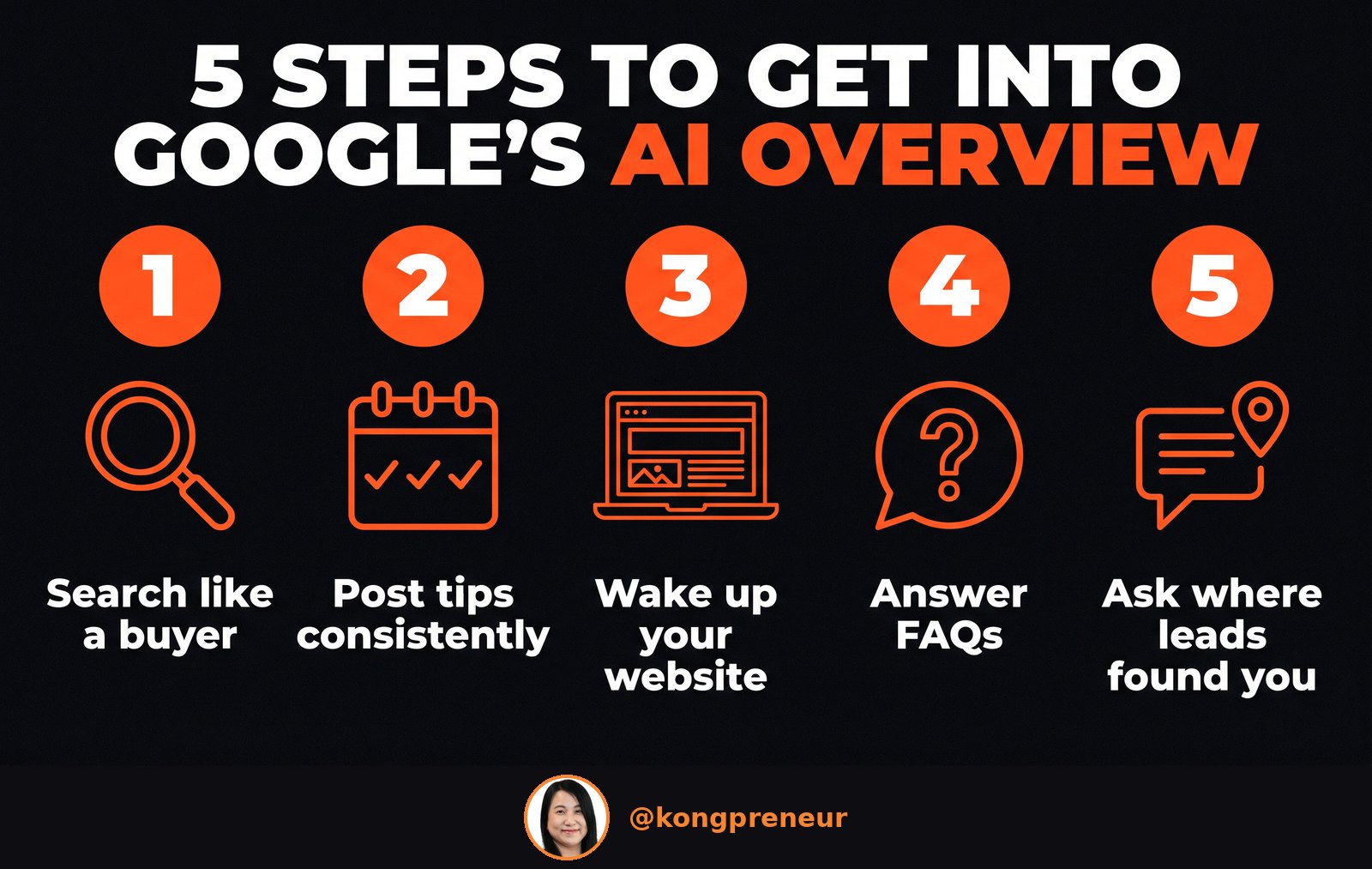
📌 Found this useful? Save this infographic or share it with a business owner you know: WhatsApp · Facebook · LinkedIn
1. Search like a buyer
Before you change anything, search for yourself the way a customer would. Don’t type your business name. Type what a stranger types when they need you: your service plus your city, or your product plus “Malaysia”. I searched “TikTok trainer Malaysia”, because that is what a business owner looking for TikTok training would type. Look at what the AI Overview says, who it names, and whether you are in it. Screenshot it. That screenshot is your starting point.
2. Post tips consistently
This is the step that changed everything for me, and it is the one most owners skip. One post a month doesn’t build a brand. Regular posts do. Share tips and real value your target customers will appreciate, the kind of thing you already explain to customers every day. In one of my videos I said it plainly: give out tips and value to your target audience, and do it consistently, every single day. For me the platform was LinkedIn. For a beauty shop it might be TikTok or Instagram. Pick the one where your buyers already are and stay there.
3. Wake up your website
A website that never changes looks abandoned, to people and to search engines. Mine was fully built and still invisible, because I had not posted or updated any blogs on it. You don’t need a redesign. You need fresh, useful posts on the site you already have, written around the questions your customers actually ask. If you don’t have a website yet, AI can help here too. I let Claude Cowork build a brand-new website on my Hostinger account, and it came out SEO friendly, with FAQs and my own images already in place. I still had to steer it, because sometimes it gives results you don’t like, but it did the heavy lifting.
4. Answer FAQs
AI Overviews are built to answer questions. Make it easy for them. Add a short FAQ section to your key pages and blog posts: a real question your customers ask, and a one- or two-sentence direct answer. Every blog on this site ends with an FAQ for exactly this reason, including this one. Keep the answers honest and specific, not salesy.
5. Ask where leads found you
When new leads started texting me, I asked them where they found me. It sounds obvious, but most owners never ask, so they never know which channel is actually working. One short question in your first reply tells you whether your posting, your website or a referral brought that customer in. Then you do more of what works.
How I beat “I don’t know what to post” with an AI employee
Knowing the steps is easy. Doing step 2 every week is the hard part, especially when you are also running the business. Before, I tried many times to get Claude to make me 90-day content sheets, but I rarely used them. A big plan doesn’t help when you sit down on a busy day and still don’t know what to post today.
What I found is that the hardest part is picking the right topic. After an on-point topic is chosen, making the caption and the image is easy, and scheduling it automatically in FeedHive makes the procrastination problem disappear. So that is how I set up my AI employee for content:
- Feed it real stories
- It picks the topic
- Answer short questions
- Approve the draft
- Schedule in FeedHive
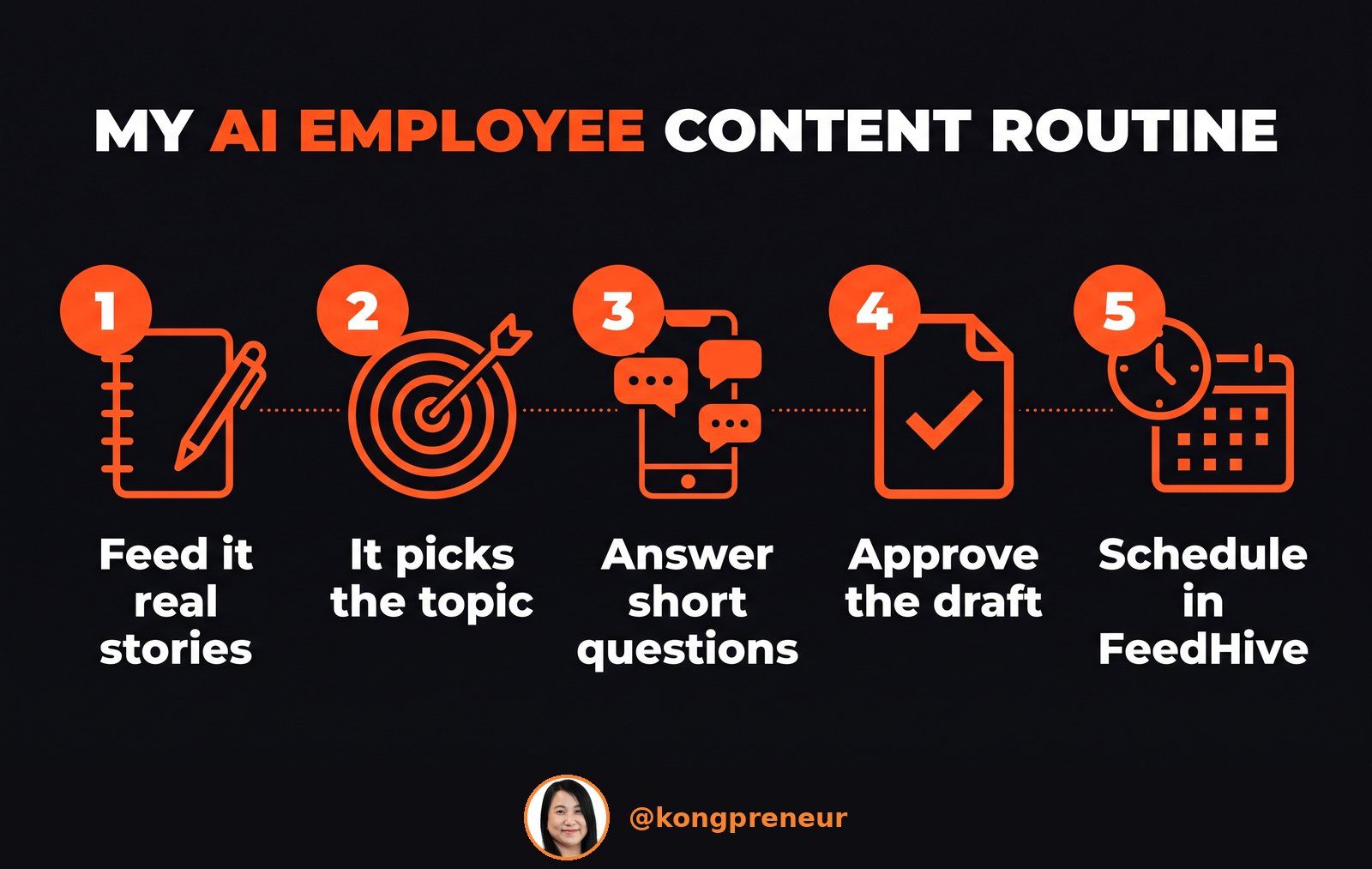
📌 Found this useful? Save this infographic or share it with a business owner you know: WhatsApp · Facebook · LinkedIn
Feed it real stories. I looked back and admitted that a lot of my older content was too generic. I hadn’t shared what I actually do to build sales. Generic content is easy to ignore, for people and for AI. So my AI employee works from my real material: my stories, my past posts, my answers.
It picks the topic. Instead of me staring at a blank page, the AI employee suggests what to post and why, based on my own material. My job is to judge, not to invent.
Answer short questions. When it needs something only I know, it interviews me on Telegram with short, specific questions. The facts in this very article came from one of those interviews. It takes me a few minutes, and my real answers are what make the content worth reading.
Approve the draft. I read it before anything goes out. AI makes the work faster, but I still decide what carries my name.
Schedule in FeedHive. Approved posts are scheduled automatically with FeedHive, so posting doesn’t depend on my mood that day.
I’m not a developer and I can’t code. I built this with Claude, the same way I explain in my guide on how to use AI for marketing as a one-person company. An AI employee like this costs a fraction of a staff cost, not zero: AI tools and generations have a real running cost, so plan for it.
Common personal branding mistakes I made
- Leaving a finished website to sit. Four years of a fully built site with no new blogs gave AI almost nothing to talk about.
- Posting in bursts. A few posts, then weeks of silence because I was overwhelmed. Consistency is what got me picked up, not volume.
- Staying generic. Content anyone could write doesn’t build your brand. Your real examples, your customers’ real questions and the things you actually do are what make you worth naming.
- Chasing likes. Engagement doesn’t pay the bills. My goal is personal branding and appearing in AI Overviews, because that is what brings leads who are ready to buy.
What to expect (and what not to)
This is not an overnight trick, and nobody controls what Google’s AI Overview shows. It changes, and it is never guaranteed. What you can control is whether there is enough useful, consistent content about you for it to find.
If you follow these steps, the realistic goal is this: when a buyer asks Google about your service or product, there is real content from you for the AI to read, your website looks alive, and you know which channel is bringing you leads. For me, that turned into new leads texting me and booking paid trainings. Your results depend on your marketing investment, consistency and product differentiation. Individual results vary, and this is not a guarantee.
As I once wrote on LinkedIn: Build Followers, and Trust, Leads & Sales will come.
FAQ
What is personal branding for a small business owner?
It is what customers, and now AI search, say about you when you are not there. For a business owner, it comes from consistent, useful content on your social media and website.
How do I get my business into Google’s AI Overview?
There is no guaranteed button, but you can give it something to read: post helpful tips consistently, keep your website updated with fresh blogs, and add clear FAQ answers. That is what worked for me.
Do I need to post every day?
You need to post consistently, on a rhythm you can keep. Regular posting beats a burst of posts followed by weeks of silence.
Does this work for physical product businesses, not just services?
Yes. Buyers search for products the same way they search for services, so a shop or e-commerce brand benefits from consistent tips and an updated website just as much as a coach or clinic does.
Can AI write my personal branding content for me?
AI can pick topics, draft and schedule, but it must work from your real stories and answers. Generic AI content won’t build trust, so always review it before it goes out.
Want an AI employee to keep your brand consistent?
If you know you should be posting but never have the time or the ideas, this is exactly what I teach. I’m a Lazada Senior Certified Trainer and HRDF Certified Trainer, and I now train business owners to build their own AI employees for marketing, with no coding needed. You’ll learn the same workflow I use to pick topics, create content and schedule it, for a service or a product business.
👉 Take a look at the AI employee training and see if it fits your business.